One More, Somewhere Else: The Nijikai Habit That Stretches a Night Without Ruining It
It's 9:40pm. The plates are cleared, the bill has been split to the penny, and everyone is standing up with that slightly flat look of a night that has technically finished but doesn't feel like it should have. In this country, that's the fork in the road. Either the group commits to a second, louder, more expensive venue and a taxi home at some ungodly hour — or everyone says their goodbyes on the pavement and is in bed by eleven.
Japan has a third option, and it's the one we've never quite learned.
What nijikai actually is
Nijikai translates, bluntly, as 'second party'. It follows the nomikai — the main drinking session, the work do, the long table of shared plates — and it is not a repeat of it. Nijikai is smaller. It's shorter. It's often unplanned, and it deliberately has no ambition to outdo the first venue.
The classic shape is a handful of people squeezing into a tiny counter bar a few minutes' walk from wherever dinner ended. One drink. Maybe two. A couple of small things to pick at. Forty-five minutes, an hour at most, and then everyone peels off, pleasantly done rather than spectacularly finished.
Crucially, nijikai is a change of tone, not a change of gear. The British instinct when a night is going well is to escalate — more people, more noise, more alcohol, bigger room. Nijikai does the opposite. It gets quieter and closes the evening down gently while there's still something left in the tank.
The two options we've been stuck with
Look at how a typical UK night out is built and the problem is structural. We book. We book the table, the time, the venue, sometimes the whole evening, weeks in advance. Once that booking is done, the night has no natural next step — so we either force one and end up in a cavernous bar playing music nobody wants at a volume nobody needs, or we don't, and we go home at a time that feels like a waste of a Friday.
The other British speciality is the marathon: the same drink, in the same glass, at the same pace, for five hours. That's not a longer night out. It's just a slower one, and everybody knows how it ends.
Nijikai sidesteps both. It works because it's small. There's no pressure on it to be the best part of the evening, so it often is.
The formula: close, small, short
If you want to build a nijikai habit of your own, almost all of the technique is in the first twenty minutes after you pay for dinner. A few principles:
- Distance is everything. Five minutes' walk, maximum. If you're getting in a taxi to the second venue, it isn't a nijikai, it's a relocation. The whole point is that the momentum carries you there, not the transport.
- No booking. Nijikai is a walk-in animal. If it needs planning, it's the main event.
- One page of food. A short, savoury-leaning menu — fried things, pickles, a bowl of rice, something grilled — is worth more than a forty-item list.
- One drink, well made. A highball, a properly built cocktail, a beer that isn't an afterthought. Not a round of shots.
- An agreed ending. Someone should say out loud, early, that this is the last stop. Sanjikai — a third party — is a thing in Japan too, and it is the beginning of a very bad morning.
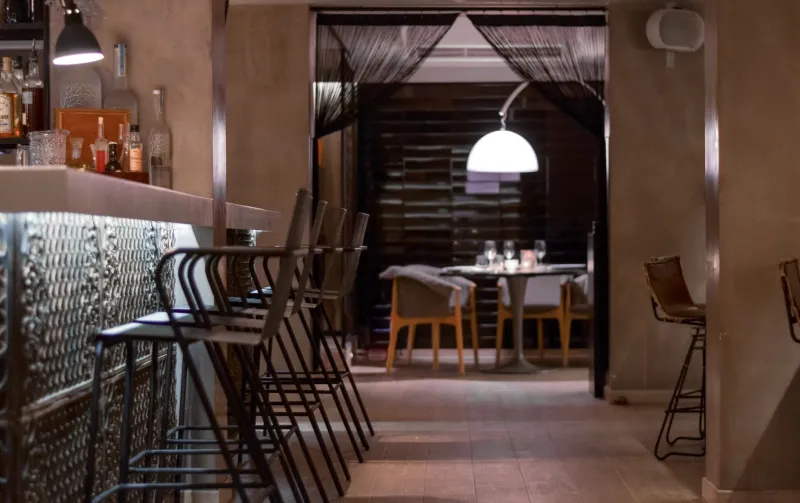
What a good second bar looks like from the door
You can usually judge a nijikai venue in about four seconds without knowing anything about it. These are the signals worth training yourself to spot:
- Spare seats at the counter. Not empty, just spare. A room with three or four free stools is a room where nobody is being managed.
- A menu you can read in twenty seconds. Small kitchens say more with less. If the food list is longer than the drinks list, someone has lost the plot.
- Light you can talk in. Low, warm, no downlights pointing at your face, no television.
- A bartender with time to look up. The single best indicator that you're in the right place.
- Licensing that gives you room. London, Manchester, Bristol, Leeds — the sensible ones all have the same problem: the 11pm wall. A second bar with a later licence, or a relaxed one, buys you the hour the rest of the night needs.
Things that should send you walking: a queue at the door, a doorman checking a list, a cocktail menu that takes twelve minutes to read, and anything that describes itself as a 'destination'.
Small plates are punctuation here, not dinner
This is the part most UK diners get wrong. You've just eaten. The food at a nijikai is not a second meal — it's punctuation. A plate of karaage. Edamame with yuzu salt. A few pickles. Maybe a bowl of rice or a small miso broth to finish, which does the job a dessert would do in a lesser evening: it signals the end.
Ordering three things between four people is about right. The moment somebody says 'shall we just get everything', you've turned a nijikai into a second dinner and lost the lightness that made it work.
The point of it
What nijikai really buys you isn't extra drinking time. It's an ending. Most nights out in this country end either too abruptly — coats on, car ordered, conversation stopped mid-sentence — or far too late, in the grey regret of a kebab shop.
The second bar gives the evening somewhere to land. You get the good part of a long night, the bit where people relax and the conversation gets interesting, without actually having a long night. It's the same reason a well-made small plate beats a huge plate of something indifferent.
So next time the bill lands and nobody's ready, don't book another table and don't call it. Find the nearest small room with a free stool, order one drink and one plate you didn't plan, and give the night a proper ending. One stop more, not five.
That's the Japanese trick. It's not about doing more — it's about knowing where to stop, and giving yourself a decent place to do it.